


题目 1
West River Glen is deciding which network architecture should replace its old copper telephone lines. The town will replace 300 miles of Outside Plant (OSP) cable that will serve approximately 2,500 homes.
The first option is to install a Fiber to the Home (FTTH) system architecture that uses fiber-optic cable to transmit signals from the source to each home. The advantages of this architecture include greater bandwidth capabilities, less signal loss, and slightly lower new-cable deployment
costs than the second option, Hybrid Fiber-Coax (HFC).
An HFC network integrates fiber-optic cables and devices with coaxial cables. This will cost the town substantially less money for internal equipment and for customer installations. However, the coaxial cable does not last as long as fiber-optic cable and will thus need to be replaced more frequently, resulting in higher long-term maintenance expenses.
The town believes that either the FTTH or HFC architectures will be capable of serving the communities' data and television needs for the next 30 years.
题目 2
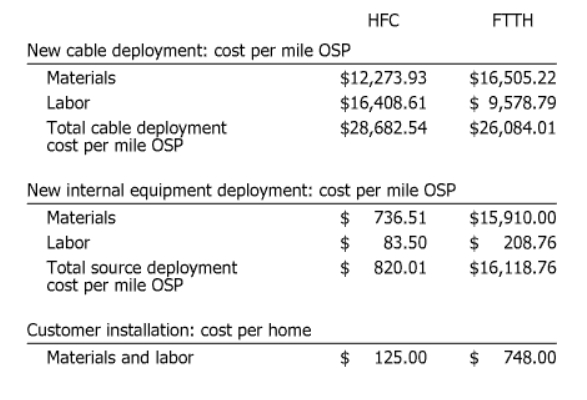
Each option for network architecture will require new cable deployment for each mile of OSP cable as well as the installation of new internal equipment. In accordance with industry standards, the cost of internal equipment is normalized to a cost per mile OSP. An installation at the home of each customer will also be required to connect to the network. The table summarizes these costs.
题目 3
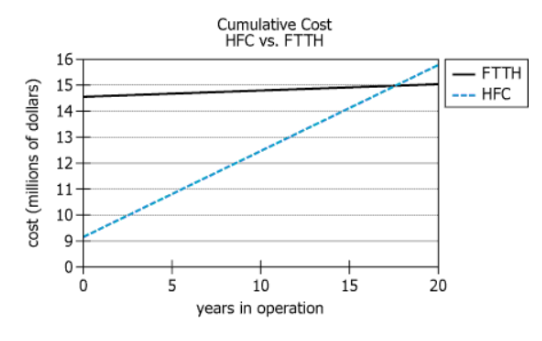
The graph shows the projected total cost of each network architecture, including initial construction (reflected in the graph as the cost at year 0) and ongoing maintenance. This assumes no homes are added and no new OSP cable is needed.
 在线客服
在线客服 官方微信
官方微信 公众号
公众号