

GMAT

题目
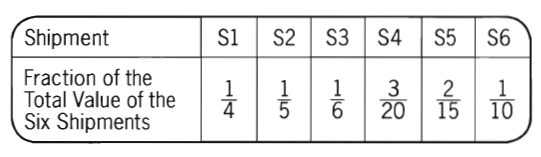
Six shipments of machine parts were shipped from a factory on two trucks, with each shipment entirely on one of the trucks. Each shipment was labeled either S1, S2, S3, S4, S5, or S6. The table shows the value of each shipment as a fraction of the total value of the six shipments. If the shipments on the first truck had a value greater than of the total value of the six shipments, was S3 shipped on the first truck?
(1) S2 and S4 were shipped on the first truck.
(1) S1 and S6 were shipped on the second truck.
解析
六批机器零件由两辆卡车从工厂运出,每批货物都完全装在其中一辆卡车上。每批货物分别标记为S1、S2、S3、S4、S5或S6。该表显示了每批货物的价值占六批货物总价值的分数。如果第一辆卡车上的货物价值大于六批货物总价值的\(\frac{1}{2}\),那么S3是装在第一辆卡车上吗?
为简化计算,假设所有货物的总价值为60(4、5、6、20、15、10的最小公倍数)。
在该假设下:
$S1=15$,$S2=12$,$S3=10$,$S4=9$,$S5=8$,$S6=6$。
同时,题目已知第一辆卡车的货物总价值**大于**$\frac{1}{2} \times 60 = 30$。
### 条件(1):S2和S4装在第一辆卡车上
$S2 + S4 = 12 + 9 = 21$。
由于第一辆卡车的总价值必须大于30,因此还需要再装载价值至少为$30-21=9$的货物。
此时$S3=10$,既可以选择装载S3(总价值$21+10=31>30$),也可以选择不装载S3(例如装载S1+S5:$21+15+8=44>30$),因此**无法确定S3是否在第一辆卡车上,条件(1)不充分**。
### 条件(2):S1和S6装在第二辆卡车上
$S1 + S6 = 15 + 6 = 21$。
如果S3也装在第二辆卡车上,那么第二辆卡车的总价值为$21+10=31$,对应的第一辆卡车总价值为$60-31=29$,**小于30**,与题目条件矛盾。
因此S3**不可能**装在第二辆卡车上,只能装在第一辆卡车上,**条件(2)充分**。
 在线客服
在线客服 官方微信
官方微信 公众号
公众号